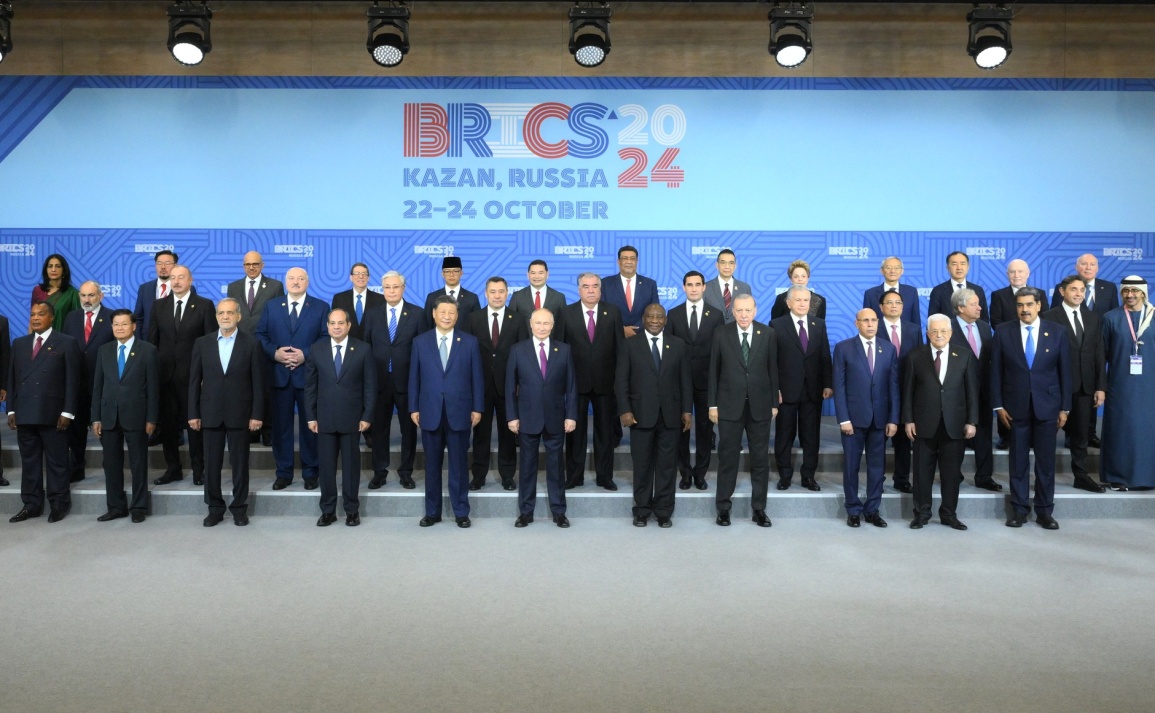
The 16th annual BRICS Summit, held in Kazan, Russia, brought together the member nations of Brazil, Russia, India, China, and South Africa, along with the newer members Egypt, Ethiopia, Iran, Saudi Arabia, and the United Arab Emirates. The summit’s central theme, “Strengthening Multilateralism for Just Global Development and Security”, underscores the group’s focus on promoting economic development among emerging markets and developing countries (EMDCs).
The Kazan Declaration, adopted by all BRICS+ members, outlines key areas of cooperation and a unified stance on various global issues, highlighting the essential role that BRICS can play in creating a more equitable and balanced multipolar world order. The summit also included meetings between leaders that aimed to strengthen relations and address existing tensions.
Here’s a summary of the key updates from the 16th BRICS Summit:
Overall Theme and Goals:
- The summit’s central theme was “Strengthening Multilateralism for Just Global Development and Security”.
- The Kazan Declaration, adopted by all BRICS+ members, focused on this theme, highlighting the essential role of BRICS in promoting economic development among emerging markets and developing countries (EMDCs).
- The declaration emphasized the emergence of new centers of power and the potential for a more equitable, democratic, and balanced multipolar world order.
- BRICS aims to expand opportunities for EMDCs and foster inclusive and equitable economic globalization.
Expansion and Partnerships:
- Thirteen “partner” nations were invited to join BRICS, with full membership expected at a later date. These include: Algeria, Belarus, Bolivia, Cuba, Indonesia, Kazakhstan, Malaysia, Nigeria, Thailand, Turkey, Uganda, Uzbekistan, and Vietnam.
- Full membership remains with the original five (Brazil, Russia, India, China, and South Africa), plus the five nations added at the start of the year (Egypt, Ethiopia, Iran, Saudi Arabia, and the United Arab Emirates).
- The declaration acknowledged “considerable interest” from countries of the Global South and endorsed the new BRICS Partner Country Category.
Economic Initiatives and Proposals:
- Russia proposed establishing a BRICS Grain Exchange to help discover fair and predictable prices for products and raw materials. The 10 BRICS members account for approximately 44% of the world’s grain production and consumption and almost 25% of global grain exports.
- The goal is to protect national markets from external interference, speculation, and artificial food shortages.
- There is potential to transform the grain exchange into a fully operational commodity exchange.
- Discussions are underway to create an international precious-metals exchange to rival existing Western exchanges like the London Metal Exchange.
- This platform would include price indicators, standards for production and trade, and instruments for market participants.
- It is intended to protect metals trading from financial sanctions.
- The BRICS group is calling for an end to unilateral coercive measures, including illegal sanctions, citing their negative impact on economic growth, human rights, and sustainable development.
- The New Development Bank (NDB) is supported as an alternative to the Western-controlled World Bank and IMF.
- The NDB is encouraged to expand local currency financing and strengthen innovation in investment tools.
- An initiative to create a new investment platform leverages the NDB’s existing structure to boost investment flows into BRICS countries and the Global South.
- BRICS is exploring the feasibility of connecting financial market systems and establishing an independent cross-border settlement and depositary infrastructure, called BRICS Clear, as well as an independent reinsurance capacity.
Geopolitical Developments:
- A productive meeting between Chinese President Xi Jinping and Indian Prime Minister Narendra Modi led to a commitment to reduce border tensions.
- Both leaders agreed to use the Special Representative mechanism (SRM) to seek a peaceful resolution.
- They affirmed that they see each other as opportunities for development, rather than threats.
- Cooperation between India and China is seen as important for economic recovery and promoting multipolarity.
- Russian President Putin and Iranian President Pezeshkian discussed strengthening bilateral ties and jointly signing a comprehensive strategic partnership, including closer defense cooperation.
- Key cooperative projects include the development of Iranian railway infrastructure, the International North-South Transport Corridor, and the construction of the Bushehr Nuclear Power Plant.
- Both leaders expressed confidence in neutralizing sanctions imposed by the US.
This summary captures the key developments and announcements from the 16th BRICS Summit, highlighting both economic and geopolitical initiatives aimed at fostering a more balanced global order.