

The tech world is currently buzzing, and while AI has been stealing the spotlight, a different kind of revolution is quietly gaining momentum: quantum computing. Google’s new quantum chip, named Willow, has arrived, not only making headlines for its unprecedented power but also for the potential disruption it could bring, especially to the world of cryptocurrency. This isn’t just another tech upgrade; it’s a potential paradigm shift that could redefine how we think about computation and security.
Willow: A Quantum Leap in Computing
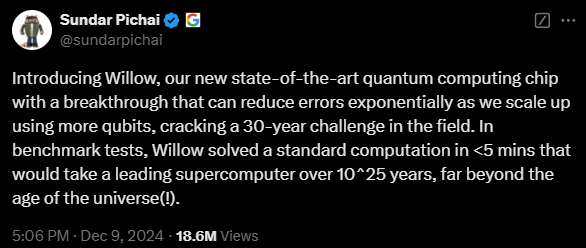
Google’s Willow chip represents a significant leap forward in computing technology. It’s designed with 70 qubits, which are the quantum equivalent of bits in classical computing. Unlike traditional bits, which can only represent a 0 or 1, qubits can exist in multiple states simultaneously. This unique capability allows Willow to perform complex calculations at incredible speeds. To put this into perspective, Willow can solve problems in mere minutes that would take traditional supercomputers millennia. Google claims that Willow has solved problems in 5 minutes that would take classical computers billions of years. This level of computing power is no longer just a concept from science fiction; it’s a reality, and its implications are far-reaching.
Bitcoin’s Looming Challenge
Bitcoin, the leading cryptocurrency, relies on robust cryptographic algorithms to secure transactions and digital wallets. These algorithms are designed to be resistant to traditional hacking methods. However, quantum computers like Willow could theoretically break this cryptography. The problem lies in the fact that quantum computers could potentially unravel Bitcoin’s public key cryptography, exposing private keys and leaving wallets vulnerable. If Willow were directed at Bitcoin’s network, it could potentially dismantle the system faster than one can say “blockchain”. The pace at which quantum technology is advancing is concerning, and Google’s work with Willow suggests that this disruption could occur sooner than many expect.
The Great Crypto Debate
The crypto community is currently divided about the immediacy of the quantum threat. Some believe that these threats are still decades away. They propose that quantum supremacy is still a work in progress and that practical applications challenging Bitcoin are 10-20 years in the future, giving Bitcoin developers time to integrate quantum-resistant algorithms. However, others argue the threat could be much closer. Adding to the uncertainty is the fact that, according to Deloitte, approximately 25% of current Bitcoins in circulation are already vulnerable to a quantum attack. The decentralized nature of Bitcoin, while a strength, might also slow down the adoption of new technology. This lag could prove critical when faced with the speed of quantum computing. Interestingly, Ethereum is already taking steps to upgrade its system to counter potential quantum computing threats, showing that not all cryptocurrencies are approaching this issue in the same way.
Navigating the Future
Looking ahead, Bitcoin developers are actively working on quantum-resistant cryptographic techniques. However, widespread adoption of these new methods could take years. The implications of quantum computing extend far beyond Bitcoin. Industries, including banking and military hardware, which depend on cryptography, may need to rethink their strategies. Google’s innovation has sparked an arms race between quantum computing and cryptographic security. It’s worth noting that Willow currently has 105 qubits, and it’s estimated that between 200 and 400 million qubits would be needed to crack Bitcoin. While this might seem like a relief, it’s also important to know that Willow can be upgraded.
The Crypto Rollercoaster Continues
For now, Bitcoin enthusiasts can take a breath, as Willow is not actively hacking wallets. However, the emergence of quantum computing has set the stage for more potential instability in the crypto world. Is this the end of Bitcoin, or an opportunity for it to evolve and become more resilient? Only time will tell, but one thing is certain: the crypto landscape has become a lot more dynamic.